Financial Management Architecture
1. Overview
|
The general-ledger parts of this page predate the current design. Posting triggers, transaction types, delta handling and account mapping through a processor on the order are superseded by General Ledger (append-only postings, accounts per organisation by role, the processor on each payment) and Income Processing (payment processors, fees, the service provider as agent, statements to the organiser). The reconciliation parts stand. |
The Financial Management architecture provides a framework for:
-
Payment Reconciliation - Importing and matching transaction data from payment processors (PayFast, PayGate) against orders
-
General Ledger Integration - Recording the financial effect of orders as GL entries with support for delta tracking
-
Journal Management - Consolidating GL transactions for export to external accounting systems
2. Problem Statement
2.1. Business Challenges
The Event and Membership System processes registrations that generate financial transactions. Several challenges exist:
| Challenge | Impact |
|---|---|
Payment verification |
Orders may be marked as paid when payment actually failed, or vice versa |
Fee tracking |
Payment processor fees are not captured, making cost analysis incomplete |
Accounting integration |
Financial data must be manually transferred to external accounting software |
Order modifications |
Changes after initial recording create discrepancies in accounting records |
Audit trail |
Difficult to trace the financial history of individual orders |
2.2. Requirements
The financial management system must:
-
Import transaction records from PayFast and PayGate
-
Match transactions to orders for payment verification
-
Calculate and apportion transaction fees across line items
-
Generate GL entries automatically when orders are paid
-
Track delta changes when orders are modified after journaling
-
Consolidate GL transactions into journals for export
-
Support journal reversal to correct errors
-
Maintain clear separation between operational (Order) and financial (GL) records
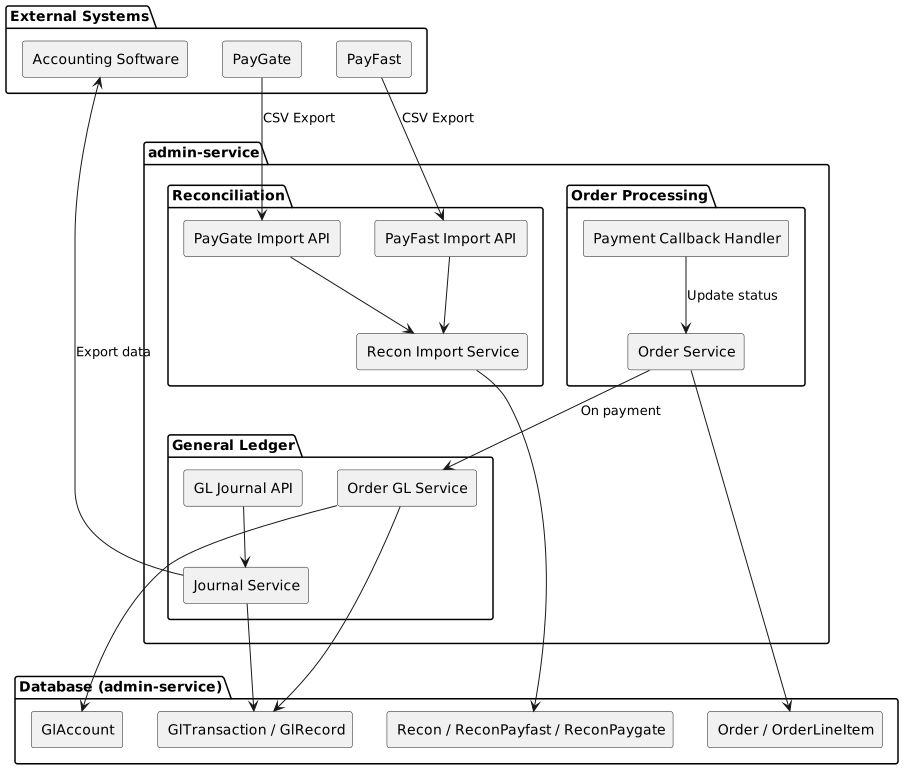
4. Component Architecture
4.1. Reconciliation Subsystem
The reconciliation subsystem imports transaction data from payment processors for verification.

Key Design Decisions:
-
JPA Inheritance (JOINED): Separate tables for processor-specific fields
-
2-char Discriminator: Compact type codes ("PF", "PG") following established enum pattern
-
Direct Import: Fixed CSV schema from payment processors, no column mapping UI required
-
Order Matching: Link recon records to orders via external reference ID
4.2. General Ledger Subsystem
The GL subsystem records the financial effect of orders using double-entry accounting principles.

Key Design Decisions:
-
GlTransaction Owns Order: FK on gl_transaction.order_id; Order has mappedBy inverse
-
GlRecord Owns OrderLineItem: FK on gl_record.order_line_item_id for traceability
-
GlTransactionType Enum: ORDER, JOURNAL, ADJUSTMENT, REFUND - no separate journal entity
-
Delta Tracking: is_delta flag on GlRecord indicates post-journal modifications
-
PaymentProcessor Account Mapping: GL accounts derived from Order.paymentProcessor (bankAccount, feeAccount, incomeAccount)
-
Journal Filter Parameters: Journals can be filtered by organisation, transactionDate, registrationSystem, and paymentProcessor


6. Transaction Type State Machine

6.1. State Descriptions
| Type | Description | Behavior |
|---|---|---|
ORDER |
Created from order payment |
Can be modified directly; eligible for journaling |
JOURNAL |
Consolidated export entry |
Cannot be modified directly; order changes create delta records |
ADJUSTMENT |
Manual correction |
Stand-alone transaction for adjustments |
REFUND |
Refund transaction |
Created when order is refunded |
7. Account Structure
GL accounts follow a standard chart of accounts pattern:
1000 - Assets
  1100 - PayFast Balance
  1200 - PayGate Balance
  1300 - Bank Account

4000 - Revenue
  4100 - Event Registration Income
  4200 - Membership Fee Income
  4300 - Product Sales Income

5000 - Expenses
  5100 - Payment Processing Fees
  5200 - Refunds Issued
Each organisation maintains its own chart of accounts, enabling multi-tenant operation with independent financial tracking.
7.1. PaymentProcessor Account Mapping
GL accounts are determined by the PaymentProcessor configured on each Order:
| PaymentProcessor Field | Account Type | Usage |
|---|---|---|
bankAccount |
Asset (1xxx) |
Debit for net payment received (consolidated per order) |
feeAccount |
Expense (5xxx) |
Debit for processing fees (per line item) |
incomeAccount |
Revenue (4xxx) |
Credit for gross income (per line item) |
This enables different payment processors to post to different accounts while using the same GL structure.
8. Integration Points
9. Related Documentation
-
Reconciliation Design - Detailed design for recon import
-
General Ledger Design - Detailed GL design
-
Financial Requirements - Business requirements
-
Financial Entities - Entity reference